MEUS Racing RC Crawler Upgrades Guide 2026 — SCX24, TRX4M, SCX30, Axles, Chassis & Wheels

MEUS Racing has developed into far more than a source of replacement crawler parts. Its current range spans high-angle axle systems, low-centre-of-gravity chassis, hard and cage-style bodies, gearboxes, links, driveshafts, servos, motors, ESCs, wheels, tyres and scale accessories across several of the most important RC crawler platforms. The useful question is therefore no longer simply “which MEUS part fits my crawler?” — it is which combination of upgrades actually improves the way that crawler is intended to work.
The MEUS Racing official store currently supports a wide range of platforms, including Axial SCX24, SCX30, AX24, Capra and SCX10-based builds, Traxxas TRX4M and larger TRX platforms, FMS FCX24 and FCX18, plus a broader selection of performance parts for other RC vehicles.
What makes the catalogue interesting from a crawler-building perspective is not simply the number of parts. MEUS increasingly designs components as connected systems: axle width affects wheel offset, steering angle affects tyre clearance, low-CG chassis geometry changes link and driveshaft requirements, and heavier metal parts change the way the suspension and servo are loaded.
This guide therefore approaches MEUS Racing as an upgrade ecosystem rather than a catalogue.
What Does MEUS Racing Actually Make?
The current MEUS range is built around most of the main systems that determine how a crawler performs and how it is packaged.
| Upgrade Area | What MEUS Offers | Why It Matters |
|---|---|---|
| Axles | Isokinetic, straight and portal axle systems across micro and 1/10 platforms | Changes steering angle, ground clearance, track width, gearing and weight distribution |
| Chassis | LCG carbon-fibre and titanium chassis, specialised MD24/Dig layouts and crawler frames | Repositions drivetrain and suspension components and can lower the crawler's centre of gravity |
| Bodies & Cages | MB-series bodies, cage shells, nylon frames and aluminium body/chassis systems | Changes packaging, weight, tyre clearance and the visual direction of the build |
| Drivetrain | Gearboxes, drive shafts, gears, links and transmission components | Controls reduction, durability, wheelbase compatibility and torque delivery |
| Steering & Electronics | Servos, motors, ESCs, servo mounts and related electronics | Allows the rest of the mechanical upgrades to operate correctly under higher loads |
| Wheels & Tyres | 0.7-, 1.0-, 1.3-, 1.9-inch and other wheel/tyre systems plus inserts | Directly affects grip, sidewall behaviour, gearing load, ground clearance and unsprung mass |
The useful way to read the MEUS catalogue: do not ask which part is “best”. Start with the limitation you are trying to solve — steering, stability, ground clearance, gearing, weight distribution, tyre grip or chassis packaging — and choose the upgrade that addresses that problem.
The Main MEUS Platforms — Where Should You Start?
This remains one of the deepest MEUS ecosystems, covering Isokinetic axles, MD24 chassis systems, bodies, servos, links, driveshafts, transmissions, wheels and tyres.
MEUS offers axle systems, portal options, chassis and body parts, transmission upgrades, driveline components, wheels, tyres and electronics for Traxxas' 1/18 crawler platform.
The newer 1/30 platform already has a dedicated MEUS ecosystem including +3mm Isokinetic axles, titanium LCG chassis parts, bodies, servos, motors, wheels and tyre inserts.
Capra, SCX10 and related DIY builds are supported through axle systems, driveshafts, wheels, tyres and other drivetrain hardware, while larger Traxxas platforms also have their own upgrade categories.
Isokinetic Axles — The Technology Most Closely Associated with MEUS
MEUS Racing's Isokinetic 3-section CVD system has become one of the brand's most recognisable crawler upgrades.
The idea is straightforward: as a conventional axle approaches a large steering angle, the driveline still needs to transmit torque smoothly through the steering joint. MEUS uses a three-section CVD architecture to increase available steering angle while reducing the rotational irregularity that can become noticeable at high lock.
Across the main current platforms, MEUS specifies up to approximately 52 degrees of steering for several SCX24, TRX4M and Capra systems, while its SCX30 Isokinetic axle is specified at 50 degrees.
But the steering figure alone is not enough to choose the axle.
Width, housing material, front/rear mass, gearing, servo architecture and compatibility with the chassis all matter just as much.
SCX24 Metal V3 — A Purpose-Built Wide Crawler Setup
The MEUS SCX24 Metal V3 Isokinetic axles illustrate why compatibility needs to be considered as a complete build decision.
MEUS widens the V3 by 9mm per side and specifies a maximum steering angle of 52 degrees. That extra width can create more tyre clearance and lateral stability, but it also changes the stance significantly compared with a stock-width or mildly widened SCX24.
This is therefore not simply a “better stock axle”. It makes most sense when a wider technical crawler is already the intended direction.
For the detailed differences between SCX30, SCX24 V2/V3, TRX4M and Capra systems, including gearing, width and steering geometry, read our dedicated MEUS Racing Isokinetic 3-Section Axles Guide.
Why Axle Width Matters as Much as Steering Angle
Wide axles are often discussed as if width were automatically an upgrade. It is not.
Increasing track width can improve lateral stability, create more clearance between tyres and suspension components and make it easier to exploit additional steering angle.
At the same time, it changes scrub radius, body-to-wheel proportions and the amount by which the tyres sit outside the body.
Keep track width proportionate to the body. Extra steering is useful, but a crawler intended to retain realistic proportions does not necessarily benefit from the widest axle available.
A wider track can be extremely useful when the entire chassis, wheel offset and tyre package are designed around additional steering and side-hill stability.
SCX30 — MEUS Has Already Built a Real Upgrade Path Around the 1/30 Platform
The Axial SCX30 is physically much smaller than an SCX24 or TRX4M, which makes seemingly small geometry changes significant.
The MEUS +3mm SCX30 Isokinetic axle adds 3mm per side, uses aluminium-alloy housings with brass front steering knuckles and is specified for a maximum steering angle of 50 degrees.
MEUS lists the axle at 66.6mm hex-to-hex, with the front assembly at approximately 29.4g and the rear at 13.3g.
That is already enough to change the dynamics of something this small.
The SCX30 ecosystem now extends further into titanium LCG chassis parts, bodies, micro servos, brushed and brushless motor options, 0.7-inch beadlock wheels and silicone tyre inserts.
SCX30 lesson: micro scale magnifies every decision. A few millimetres of axle width, a few grams of unsprung mass or a different wheel offset can represent a much larger percentage change than the same modification on a 1/10 crawler.
MD24 and LCG Chassis — Changing the Architecture, Not Just the Parts
Axles receive much of the attention, but chassis design is where a crawler can change most fundamentally.
The MEUS MD24 Titanium LCG chassis is a good example.
It uses a TC4 titanium frame, a 20-degree angled chassis design and a POM skid plate, with versions offered around conventional and Dig-oriented layouts.
The Dig version integrates a mechanism intended to disconnect the rear driveshaft so that the rear axle can lock, reducing turning radius and giving the driver another way to position the crawler in technical sections.
This type of upgrade needs to be planned as a system.
The chassis affects link lengths, driveshaft angles, motor and transmission packaging, shock location, servo installation and body choice. MEUS itself lists recommended combinations for links, driveshafts, transmission, motor, servo, axle and shocks.
Do not treat an LCG chassis as an isolated bolt-on. Once the chassis becomes the foundation of the build, the correct question is not “will this fit?” but “which complete geometry am I building around it?”
Bodies and Cages — Performance Packaging with a Visual Identity
MEUS also uses body design as part of the crawler architecture.
The current catalogue includes MB-series bodies, lightweight cage bodies, nylon frames, carbon-fibre structures, clear shells and more specialised aluminium body/chassis systems.
On a micro crawler, the body is not just cosmetic.
A lower or narrower body can create tyre clearance. A cage can reduce upper weight. A larger hard-style shell can provide more scale presence but may change the centre of gravity and packaging around electronics.
This is why the body should be selected together with the intended tyre diameter, axle width and chassis geometry.
If you want to explore the complete SCX24 ecosystem in more detail, our existing Best MEUS Racing SCX24 Upgrades Guide goes deeper into the platform-specific choices.
TRX4M — The Important Choice Is Stock-Compatible vs Custom Build
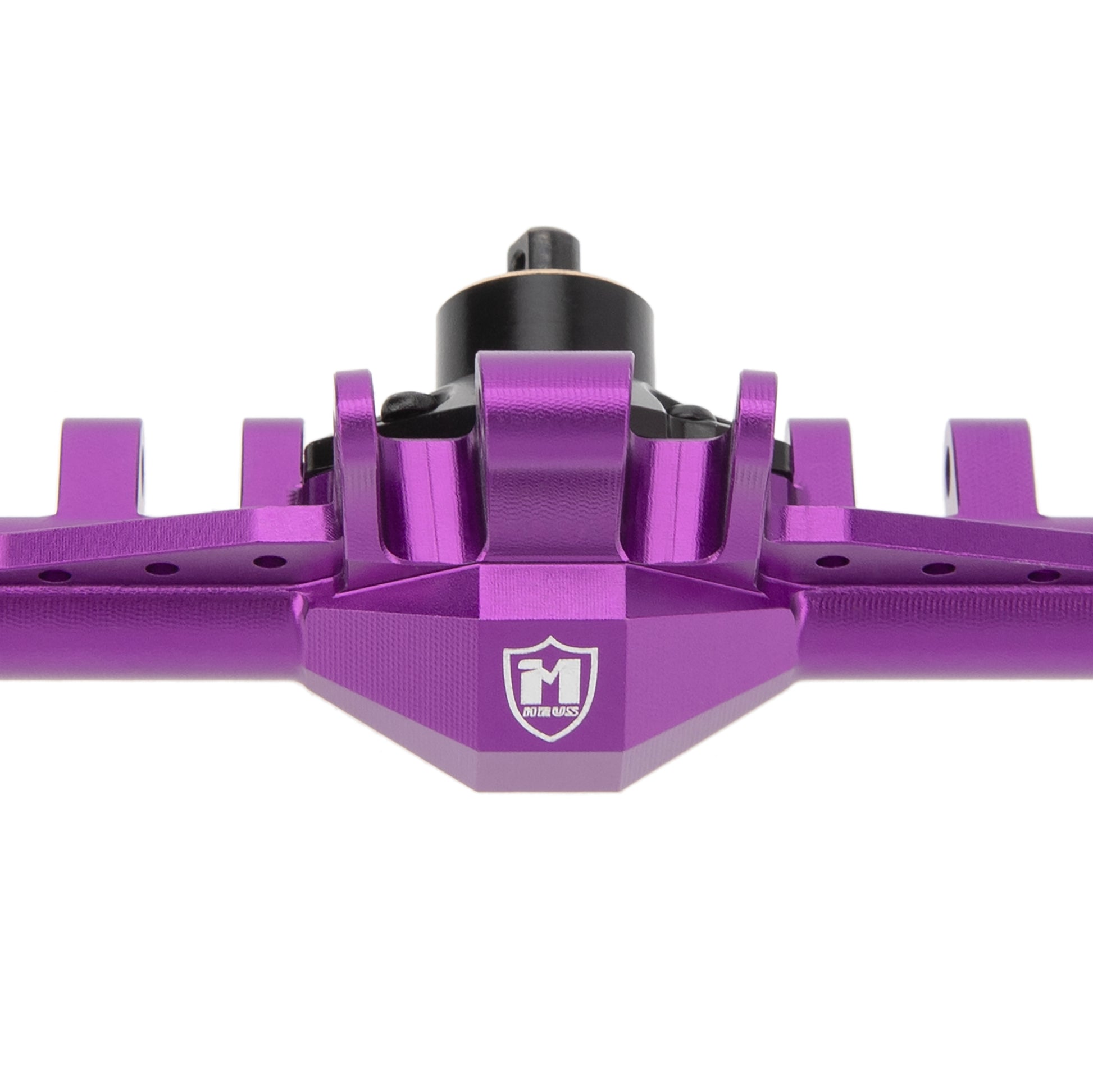
TRX4M V2 Isokinetic Axles
The TRX4M V2 Metal Isokinetic axle system demonstrates why “TRX4M upgrade” is too broad a phrase on its own.
The V2 uses a more specialised servo architecture and MEUS specifically notes that it is not intended to work with the stock TRX4M chassis and stock vertical servo arrangement.
That makes it more appropriate for a custom-chassis build than for someone who wants to replace the axles on an otherwise standard truck.
For a lightly modified Bronco, Defender or High Trail, the smartest MEUS purchase may therefore be tyres, wheels, driveshafts, steering or another stock-compatible component rather than immediately choosing the most specialised axle system.
For a full custom TRX4M, however, the wider chassis ecosystem opens far more possibilities.
Explore MEUS Racing TRX4M Upgrades
Browse current axle, drivetrain, chassis, suspension, wheel, tyre and electronic upgrades for the Traxxas 1/18 crawler platform.
Wheels and Tyres — Often a Better First Upgrade Than Metal Hardware
It is very easy to start an upgrade build with shiny aluminium and brass parts.
In practice, tyres can change a crawler more immediately than many expensive mechanical components.
Grip compound, tread pattern, diameter, sidewall stiffness and insert behaviour determine how effectively the crawler converts its drivetrain torque into movement.
MEUS currently offers wheel and tyre systems from micro 0.7-inch SCX30 hardware through 1.0- and 1.3-inch micro crawler options and larger 1.9-inch/2.2-inch configurations.
The MEUS 1.0-inch aluminium beadlock wheel range, for example, is designed across platforms including SCX24, TRX4M, AX24 and FCX24.
That cross-platform compatibility is useful, but wheel diameter alone does not guarantee a good setup. Offset, hex clearance, tyre diameter and body interference still need to be checked.
Why Beadlocks Matter
A beadlock wheel mechanically captures the tyre bead rather than relying on adhesive.
That makes tyre changes and insert experimentation much easier and is particularly useful for crawlers where tyre tuning is part of the setup process.
It also means wheel weight becomes another tuning variable.
More rotating and unsprung mass can improve planted feel and lower the effective centre of gravity, but it also adds load to the servo, drivetrain and motor. More weight is therefore not automatically better.
Brass — Useful When It Is in the Right Place
Brass parts are popular because they put mass low on the crawler.
That can help climbing and stability, especially when concentrated around the front axle and steering assembly.
But the goal should not be to make the vehicle as heavy as possible.
Front steering knuckles, differential covers or carefully selected wheel components can place weight low and forward where it can contribute to climbing behaviour.
Adding heavy parts everywhere can increase total mass without improving balance, while placing more stress on steering, motor and drivetrain components.
The better approach is deliberate weight distribution.
Links and Driveshafts — Geometry Before Strength
Metal links and driveshafts are often sold as durability upgrades, but geometry is at least as important as material.
Link length determines wheelbase and axle position. Link bend affects clearance beneath the chassis. Driveshaft length and operating angle need to match the resulting axle and transmission positions.
This becomes especially important once an LCG or extended-wheelbase chassis is installed.
MEUS offers platform-specific and cut-to-length driveshaft options for exactly this reason: custom builds do not always remain inside stock dimensions.
Upgrade order matters: decide the chassis and wheelbase first, then links and driveshafts. Buying drivetrain lengths before finalising the crawler's geometry is an easy way to buy the same part twice.
Gearboxes, Overdrive and Underdrive
MEUS also supports drivetrain tuning through gearbox and axle gearing options.
Overdrive makes one axle rotate faster relative to the other; underdrive makes it rotate more slowly.
On a technical crawler, making the front axle effectively pull slightly faster than the rear can help the vehicle rotate around tight obstacles and can reduce the tendency for the rear axle to push the chassis straight ahead during a climb.
But gearing changes also alter driveline load and handling.
They should therefore come after tyres, steering and the basic geometry are working correctly — not before.
Electronics — The Mechanical Build Has to Be Powered Properly
MEUS increasingly offers the electronics required to support its mechanical ecosystem, including brushed and brushless ESCs, micro motors, high-torque servos and radio equipment.
This matters because stronger steering geometry only works if the servo can actually move the tyres under load.
Likewise, adding weight and larger tyres increases the demand placed on motor and drivetrain components.
The electronics should therefore be selected around the finished crawler rather than treated as an unrelated upgrade category.
1/10 MEUS Racing Upgrades — The Same Ideas at a Larger Scale
The MEUS catalogue extends well beyond micro crawlers.
For Axial Capra, SCX10 and related DIY platforms, the same design themes appear again: Isokinetic and portal axles, 4WS configurations, driveshafts, wheels, tyres, steering components and drivetrain parts.
The larger scale changes the loads involved, but not the underlying build logic.
Track width, servo position, caster, kingpin angle, portal gearing, wheel offset and axle compatibility still need to be treated as one system.
In particular, the MEUS CHEAT CODE / Capra-style Isokinetic axle family is not simply a large version of an SCX24 axle. It is designed around different steering layouts, including SOA/BTA servo arrangements and 4WS configurations.
What Should You Upgrade First?
| Your Problem | Start With | Do Not Assume |
|---|---|---|
| Poor grip | Tyres, inserts and wheel setup | That heavier axles will fix tyre traction |
| Limited steering | Steering geometry, servo clearance and axle architecture | That maximum advertised steering angle will work with every wheel/body setup |
| High centre of gravity | Chassis layout and controlled low-mounted weight | That adding brass everywhere is the same as lowering CG |
| Drivetrain flex or failure | Driveshafts, gears and transmission components | That the strongest part automatically has the best geometry |
| Poor breakover clearance | Skid/chassis geometry and link shape | That taller tyres are the only solution |
| Large turning radius | Steering angle, gearing and potentially Dig/4WS | That one modification alone solves the entire turning geometry |
Five Sensible MEUS Build Directions
Keep axle width moderate, prioritise tyres and realistic wheel fitment, improve steering where necessary and avoid excessive weight that compromises scale behaviour.
Build around Isokinetic axles, LCG chassis geometry, deliberate front-biased weight and tyre clearance. Choose V2 or V3 width according to the intended stance.
Plan chassis, servo architecture and axle choice together. A specialised axle such as TRX4M V2 makes more sense once the crawler is already moving beyond stock packaging.
Use small changes carefully. Axle width, wheel offset, servo weight and tyre diameter all represent large proportional changes on the 1/30 platform.
Plan around steering layout, portal geometry, wheel offset and intended 4WS or conventional front-steer architecture before ordering axle hardware.
Some MEUS wheels and tyres support multiple micro platforms. Use this flexibility to tune grip and stance, but verify offset and clearance rather than relying only on nominal wheel size.
What I Would Buy First from MEUS Racing
If I were starting with a mostly stock crawler, I would not begin with the largest mechanical upgrade available.
I would first decide whether the current limitation is traction, steering, ground clearance, weight distribution or drivetrain durability.
For many crawlers, tyres and a properly chosen beadlock wheel package are the most rational first step because they immediately affect the contact patch between the vehicle and the terrain.
If steering is the real problem, that is where the MEUS Isokinetic axle ecosystem becomes compelling.
If the crawler is becoming a ground-up technical build, then the chassis should move to the front of the decision process. At that point an MD24, titanium LCG frame, Dig architecture or another specialist platform can define the rest of the parts list.
The important thing is to avoid buying parts in the reverse order.
Explore MEUS Racing RC Crawler Upgrades
Browse current axles, chassis systems, bodies, drivetrains, electronics, wheels, tyres and scale crawler components directly from MEUS Racing.
Why MEUS Racing Works Best as an Ecosystem
The strongest reason to consider MEUS is not any single aluminium or brass component.
It is the depth of compatible systems around the main crawler platforms.
An SCX24 builder can move from wheels and tyres into axles, then chassis, drivetrain and electronics without immediately leaving the same engineering ecosystem.
A TRX4M builder can choose between relatively stock-compatible components and a much more specialised custom build.
SCX30 already has a surprisingly mature upgrade path for such a small and relatively new platform.
And at 1/10 scale, MEUS continues the same emphasis on steering geometry, portal systems and crawler-specific drivetrain design.
That breadth is useful because good crawler builds are rarely created by one spectacular component. They are created by parts that work together.
Final Thoughts
MEUS Racing is most interesting when you stop looking at the catalogue as a collection of isolated upgrades.
The brand's Isokinetic axle systems get much of the attention, but the chassis, drivetrain, wheel, tyre and electronic ecosystems are what allow those axles to become part of a coherent crawler.
For a lightly modified vehicle, the best MEUS purchase may be simple: tyres, beadlock wheels, driveshafts or steering hardware.
For a more serious technical build, axle width, chassis geometry, link length, servo position, gearing and weight distribution need to be planned together.
That is particularly true with platforms such as the SCX24 and TRX4M, where the difference between a stock-based upgrade and a ground-up custom crawler can become significant very quickly.
Buy the upgrade that solves the actual limitation. Then build the rest of the crawler around a clear objective rather than around a pile of parts.
That approach usually produces a better-performing vehicle — and a much more satisfying build.
Browse the Scale & Motion Catalogue
Explore RC crawlers, scale vehicles, model kits, paints, tools and selected hobby products through the Scale & Motion curated hobby catalogue.
Further Reading
- MEUS Racing Isokinetic 3-Section Axles — SCX24, SCX30, TRX4M & Capra Guide
- Best MEUS Racing SCX24 Upgrades — Axles, Chassis, Body & Drivetrain Guide
- FMS FCX24M Land Rover Upgrade Guide — Wheels, Tyres, Brass, Steering & Bumpers
- WPL RC Buying Guide 2026 — B, C, D & E Series, RTR vs KIT vs KM, Upgrades & Parts
This site may contain affiliate links, sponsored links, paid links or referral links to external retailers, manufacturers, marketplaces and affiliate partner stores. If you click through and make a purchase, a small commission or store credit may be earned at no extra cost to you. These commissions help keep Scale & Motion running.
Scale & Motion does not sell products directly, process payments, manage orders, handle shipping, or provide after-sales support. All transactions, product quality, delivery, returns, warranties and customer service remain the sole responsibility of the respective seller, retailer, marketplace or manufacturer.
Editorial note: Articles on this site are produced from research, product information, retailer information, manufacturer details and editorial comparison. They are intended as independent editorial guides, not hands-on reviews, unless explicitly stated.
Accuracy note: Product specifications, compatibility details, body mounting systems, electronics, chassis differences, accessories, fitment, availability and product images may vary by model, version, retailer listing or manufacturer update. Readers should always confirm final details directly with the retailer or manufacturer before purchasing.
All images, logos, product names, brand names and trademarks remain the property of their respective owners. Product images are used for editorial, informational and illustrative purposes only. Images used in an article may not correspond exactly to the products promoted through affiliate links.
If you are a rights holder, content creator, retailer or manufacturer and wish to request credit, correction, update or removal of content, please contact Scale & Motion directly.
This site uses cookies and may contain affiliate links. By using this site, you accept the Privacy Policy. Read more.
The information provided on this site is for editorial, educational, historical, hobby and informational purposes only. Readers are encouraged to conduct their own research and verify product details before making any buying decisions.


